Airsoft & Air Rifle Shooting Targets Ranking 2026
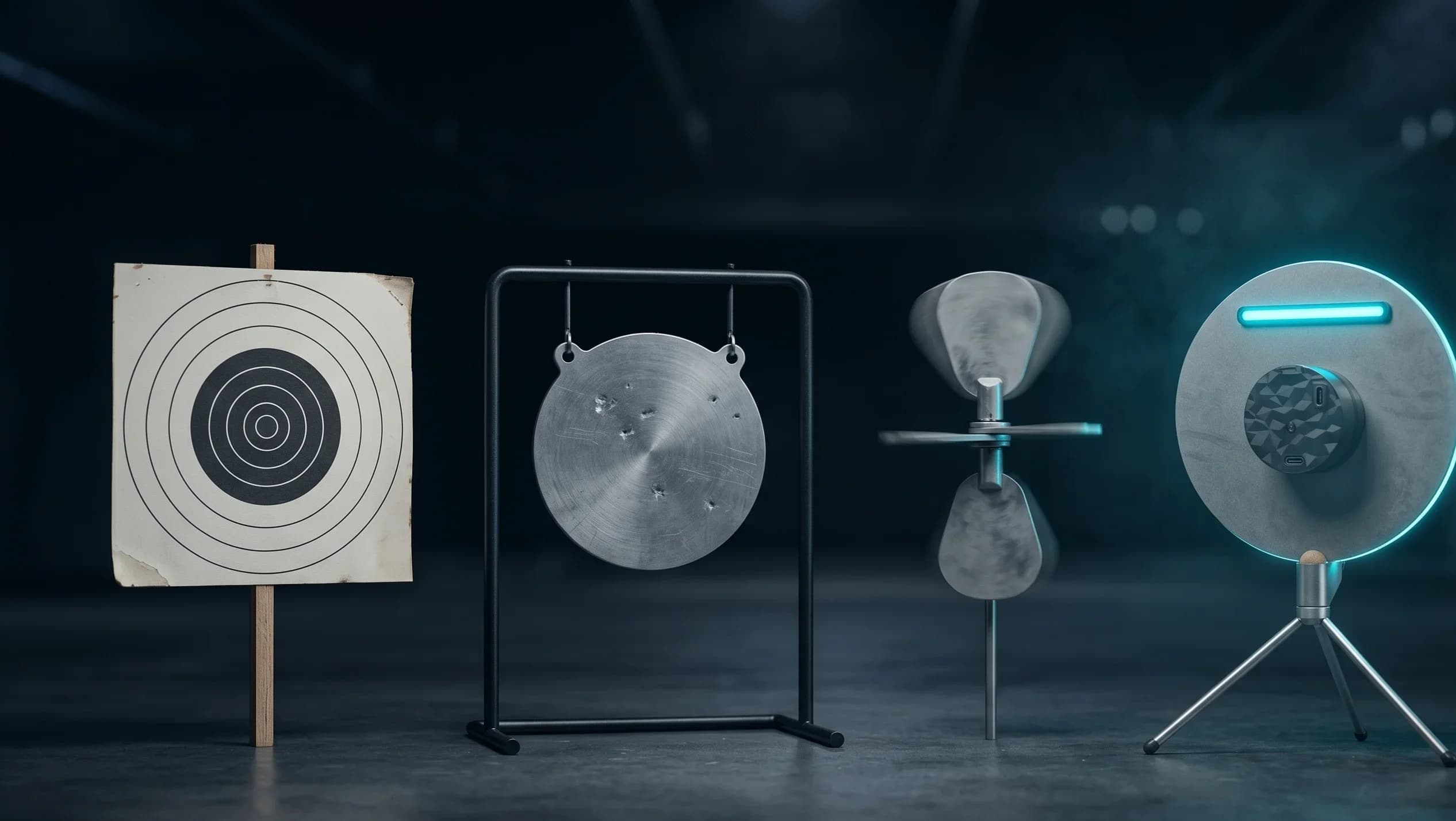
Every shooter has a favourite type of target and is firmly convinced that everything else is heresy. Paper purists look down on the "steel crowd", gong owners say cardboard is boring, and electronics fans claim there is no real training without an app. The truth? Everyone is partially right.
This airsoft shooting targets ranking compares five categories you can realistically buy in 2026 — from a 0.30 EUR paper target to an electronic system with a mobile app. No nonsense, no pushing one solution, with concrete prices and "what to buy if..." scenarios.
As Wiktor, the airsoft tactician on the Aimora team, says: the best target is the one you actually use regularly. Everything else is detail.
1. Paper targets — the classic nobody beats on precision
The simplest, cheapest, and still the most precise tool for measuring grouping. If you want to know whether your air rifle shoots a 1 cm or a 4 cm group at 10 m — paper will tell you. Steel will not.
Price: 0.10–2 EUR per sheet. DIY backstop from a cardboard box and an old mattress: free. A proper trap backstop with steel and rubber: 40–100 EUR.
Pros:
- Cheap as chips
- Full grouping information — you see exactly where each shot landed
- Standard in competitive shooting (ISSF, IPSC, BR)
- Works with anything — from a 4.5 mm air rifle to a centre-fire rifle
Cons:
- You have to walk up and check
- Zero feedback during the string
- Gets boring after 30 minutes
Best for: precision air rifle training, scope zeroing, IPSC slow fire, any "cold" grouping drill.
One IPSC sniper friend puts it bluntly: "Steel lies. You hit the edge of a gong — sounds the same as an X-ring. Paper never lies." Hard to argue with that.
2. Steel targets — gongs, knock-downs, poppers
Steel and aluminium plates, silhouettes, dueling pieces. A hit means sound plus movement. This is the dopamine "ping" that keeps people on the range longer.
Materials matter — this is not optional:
- AR500/AR550 steel — for firearms (pistol, rifle)
- Mild steel S235 — ONLY airsoft and air rifle. Risk of ricochet with firearms
- Aluminium 3 mm+ — airsoft, air rifle up to ~15 J
- HDPE plastic — the cheapest airsoft option
Prices: ⌀10 cm aluminium gong — 10–20 EUR. Airsoft knock-down — 20–50 EUR. AR500 IPSC popper — 100–225 EUR.
Safety (non-negotiable): minimum distance 9 m for firearms, 5 m for air rifles >17 J, 3 m for airsoft. Target angled 15–20° downward (ricochets head to the ground, not your face). Ballistic eyewear ALWAYS.
Pros: instant feedback, lifespan 100,000+ hits, works in the field. Cons: no precise hit location, noise, knock-downs need resetting.
Best for: dynamic drills, airsoft CQB, plinking, IPSC, draw-from-holster practice.
3. Reactive targets — spinners and dual targets
Mechanical, no electronics. A hit causes rotation or swing. Most popular types: single spinner, dual spinner (spins forever as long as you keep hitting), plate rack (a row of plates).
Limitation: mostly airsoft and air rifle. There are AR500 versions for firearms, but prices start around 150 EUR per piece and climb fast. An air rifle above 15 J will destroy cheap spinners — check plate thickness (3 mm minimum).
Real-world lifespan:
- Cheap imports: 3–6 months
- Mid-tier (aluminium with a decent axle): 2–3 years
- Steel with bearings: 5+ years
The weak point is always the axle — not the plate.
Prices: airsoft spinner — 8–20 EUR. Dual spinner — 20–50 EUR. Plate rack — 60–150 EUR. Auto-reset versions — 150–375 EUR.
Pros: fun factor, great for tempo training, no batteries. Cons: mechanics wear out, no time or score measurement.
4. Self-resetting targets — let the spring do the work
They return to the starting position automatically after 1–3 seconds. Spring or gravity driven. Types: spring knock-down, pop-up (jumps out of the ground), and dueling tree — a tree with 6 plates for 1v1 play (whoever flips all plates to the opponent's side first, wins).
Difference vs reactive: here you have state A (ready) and B (hit), with automatic A→B→A return. Reactive targets only rotate.
Prices: airsoft pop-up — 35–100 EUR. Spring knock-down — 50–125 EUR. Airsoft dueling tree — 100–225 EUR. AR500 firearm dueling tree — 500–1250 EUR.
Pros: solo training without walking up, dueling tree is an unbeatable event attraction. Cons: springs wear out after 5,000–10,000 hits, training pace dictated by reset time.
A home range that doesn't get boring after a week?
A mix of paper, two spinners and one smart Aimora target (≈ 99 EUR) gives you precision, dynamics and measurable progress — in a single setup.
See Aimora5. Electronic targets — smart targets
The premium tier. Electronic hit sensor + mobile app + statistics + game modes. A hit no longer ends at "ping" — it appears in the app as a score, reaction time, hit percentage and leaderboard position.
What this category actually offers:
- Instant hit detection with sensitivity calibration
- Mobile app with game modes (reaction, sequences, duel, memory)
- LED indicators on the target
- Time measurement in milliseconds
- Wireless connection to your phone
- Firmware updates from the app
- Multi-target operation
The Polish market is bleak. Imported smart targets from the US/UK cost 700–1900 EUR per unit, plus customs, with no local service. DIY Arduino builds work, but without an app it is more of a toy than a training system.
Where Aimora sits (~99 EUR for detector + LED indicator + 2 reflectors):
- 7 game modes: Easy Training, Time Attack, Max Hits, Duel, Hostage, Shoot-Off, Memory Shot
- BLE link to the Shooting Buddy app
- Precise hit detection (works with airsoft, air rifles, .22 LR)
- ~5 h battery life, magnetic mount (seconds to set up)
- OTA firmware updates
- Polish manufacturer, local service
Global competition? SIRT and MantisX are firearm-mounted systems (they measure barrel movement, not hits — different category). Range Systems and Action Target are commercial installations starting around 12,000 EUR. Laserlyte and iTarget are dry-fire systems (no physical projectile).
Aimora is effectively the only consumer-priced option for "physical electronic target with a mobile app" in the Polish e-commerce market. Not because it is the best in some abstract sense — but because at that price point there is nothing comparable.
Pros: you measure everything, fun and measurability at the same time, solo training with feedback, events with leaderboards. Cons: needs a battery and a phone, higher entry price, sensitive to rain and frost.
Best for: people training at home or in a garage who want measurable progress, event organisers, commercial ranges. If your goal is improving accuracy systematically, real-time feedback makes a huge difference.
Comparison table — all categories on one screen
| Category | Price/unit | Airsoft | Air rifle | Firearms | Feedback | Noise | Mobility | Best for |
|---|---|---|---|---|---|---|---|---|
| Paper | 0.10–2 EUR | Yes | Yes | Yes | Visual, delayed | Quiet (only the shot) | Very high | Precision, zeroing, IPSC slow fire |
| Steel | 10–225 EUR | Yes | Yes | Yes (AR500) | Sound + motion | Loud (metallic ping) | Medium | Dynamics, plinking |
| Reactive | 8–150 EUR | Yes | Yes | Rare | Visual, motion | Medium (mechanics + impact) | High | Fun, tempo training |
| Self-resetting | 35–1250 EUR | Yes | Yes | Yes (pricey) | Visual + auto-reset | Medium (spring + reset) | Medium | Solo, 1v1 events |
| Electronic | 99–1900 EUR | Yes | Yes | Model-dependent | Sound + LED + app + stats | Quiet (LED + app feedback) | High | Measurable progress, events |
What to buy if... — 6 budget scenarios
1. Starting out, budget under 120 EUR: 20 paper targets (6 EUR) + DIY backstop (free) + one aluminium spinner (12 EUR). Paper won't lie to you, the spinner adds fun. Spend the rest on pellets and coffee.
2. Home/garage CQB, budget 120–230 EUR: Aimora (~99 EUR) + 2–3 aluminium spinners (35 EUR) + paper and a backstop (35 EUR). Triple package: precision on paper, dynamics on spinners, measurable progress in the app. The setup won't get boring after a week.
3. Running airsoft competitions, budget from 500 EUR: 3–5 Aimora sets (~297–495 EUR) + dueling tree (115–185 EUR) + plate rack. App-based leaderboard plus a 1v1 attraction equals an event people come back to.
4. Air rifle, regular precision training: Trap backstop (50 EUR) + paper supply (12 EUR) + a single 3 mm steel gong as a "reward" after a clean group (15 EUR). Around 77 EUR total. Cheap and effective.
5. Commercial range, budget from 1100 EUR: 8–10 Aimora sets + 5–6 AR500 poppers + dueling tree. Sales pitch for customers: a league with rankings, measurable progress, weekend events. Smart targets are a real competitive advantage today.
6. Precision purist, sniper-style: Paper. Only paper. No discussion.
Measurable progress for ≈ 99 EUR
Aimora is the only consumer-priced Polish electronic target with a mobile app. 7 game modes, BLE, 5 h on a battery, OTA. Works with airsoft, air rifles and .22 LR.
Check the starter kitSummary — there is no "best" target
The whole ranking boils down to one thing: there is no universally best target — there is only the best target for your training goal.
- Training precision? Paper.
- Training dynamics? Steel.
- Want fun without batteries? Reactive.
- Solo training without walking up? Self-resetting.
- Measurable progress and events? Electronics.
The smartest setups mix 2–3 categories. Paper for diagnostics, steel or spinners for dynamics, electronics for measurable progress and competition. Together they form a system that grows with you — from your first strings to club-level matches.
And one more thing Wiktor keeps repeating: the most expensive target in the world won't replace 30 minutes of training a week. Habit first, gear second.