How to Run a Club Shoot: Scoring, Running Order, Standings
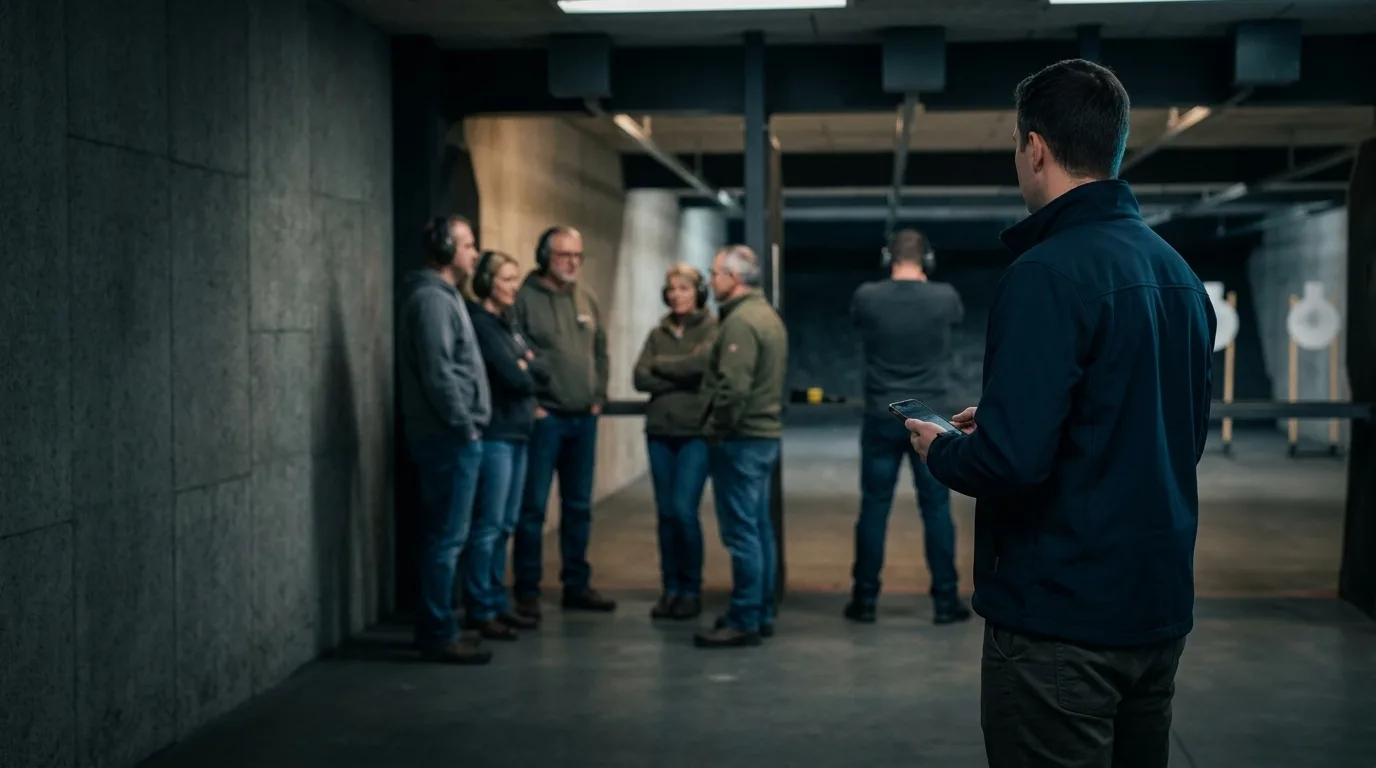
Your club night deserves better than a clipboard. Twelve people turn up, you have one firing point, and for the first half hour everything is brilliant — people are shooting, laughing, somebody hits far better than they expected. An hour in, the questions start, and nobody can answer them quickly: has Sarah shot this one yet? what did Tom get? who's actually winning? The person running the evening is tracing a finger down a sheet of paper where three columns hold three different units and two names have a question mark beside them.
This is not an equipment problem. Running a proper club shoot doesn't need better rifles or more expensive targets — it needs two things settled before the first shot: the running order and the scoring. Both have well-established solutions that work identically for air rifle, airsoft and smallbore, and both can be applied with a pencil if that's all you've got to hand.
This article works through everything you need to decide to make a group competition land: how many stages to run, how to turn results from different events into one table, what order people shoot in, what to do about ties, how long it honestly takes, and what to hand people at the end. Only in the second half do we get to what a piece of software can take off your plate — because the rules matter more than the tool and they work without it.
Why a Club Shoot on Paper Falls Apart
Paper doesn't fail because it's paper. It fails at three specific moments, and each one is predictable.
The match director is looking at the sheet instead of the firing point. That is the one thing they are genuinely responsible for. Writing down a score takes fifteen seconds, and those fifteen seconds land exactly when one shooter is stepping off the line and the next is stepping on — the only part of the run where something can actually go wrong. The better the shoot, the more often that moment repeats.
After the third stage nobody knows who's leading. The tension in a competition doesn't come from the shooting itself; it comes from knowing that two points separate you from second place. If the standings exist only in the organiser's head and take five minutes to work out, the group loses its edge precisely when it should be sharpest: in the final stage.
Results come in incompatible units. One stage measures hits in thirty seconds, another measures the time taken to land twenty hits. Fourteen hits and 41 seconds are not numbers you may add together. Most improvised club competitions come apart right here: not on organisation, but on arithmetic.
A Spreadsheet Is Not a Solution, Only a Delay
A spreadsheet does everything you need: it sorts, it sums, it draws the table. The problem is not the spreadsheet; it's that somebody has to be sitting at it.
At a range, that somebody is also the range officer, watching the line and explaining the basics to a person holding an air rifle for the first time in their life. The spreadsheet works beautifully on Monday evening when you type the results up from notes. It does not work at twenty to nine on a club night when the twelfth shooter steps off the line and the laptop is two metres away under somebody's coat.
What a Club Shoot Needs in Order Not to Collapse
Five things have to be settled before the first shot. That's the whole list. Answer these and the evening will hold together whether you run it on a phone or a clipboard:
- How many stages, and which ones. This number alone sets how long the evening runs.
- How raw results convert into points. Without this you cannot combine hits with seconds.
- What order people shoot in — and whether that order changes between stages.
- What happens on a tie. A tie for first is a different question from a tie for ninth.
- How you announce the results. Out loud, on paper, or in a form people take away with them.
The rest of this article answers those five questions in order.
Formal Match Software Solves a Different Problem
Worth drawing the boundary early, because this is most of what you'll find if you go searching. PractiScore, Score-Shot and similar tools are match-office systems: registration, squadding, an RO entering scores on a tablet, Hit Factor, live results on a screen. They are good at what they were built for — a sanctioned match with a published programme, a squad list and an official at every bay.
An informal club shoot for whoever walked through the door has neither registration nor an official to enter scores. It has one person running it, twelve shooters of whom half have never competed, and two hours. That's a different job, and it usually needs a good rule rather than a system. If you're still weighing up the kit side of this, we've written separately about what electronic targets do for clubs and ranges; this article is about what you actually do with them on a club night.
Scoring — Turning Different Stages Into One Leaderboard
This is the heart of it. Get the scoring right and everything else is logistics.
The Formula
After each stage you sort the results and award points by one rule:
points = number of shooters − placing + 1
With twelve shooters that looks like this:
| Placing | Points |
|---|---|
| 1st | 12 |
| 2nd | 11 |
| 3rd | 10 |
| … | … |
| 11th | 2 |
| 12th | 1 |
The overall standings are simply the sum of points across all stages. Nothing else needs calculating, and every competitor can check it themselves, which matters more than it sounds, because a competition whose scoring nobody understands produces arguments instead of excitement.
Three Ways to Score, and Why We Use This One
There are really three models on the table, and it's worth seeing all three before picking.
Fixed ladder (10-8-6-5-4-3-2-1). Tempting because it looks familiar from motorsport. It has one flaw that appears immediately with a decent turnout: with twelve shooters, an eight-deep ladder gives zero points to four people. Those four are mathematically out of the competition after the first stage, and they know it. At a club night where half the room has never shot competitively, that is the worst possible design decision. A beginner who knows by stage two that there's nothing left to chase stops trying and starts looking at their phone.
Percentage of stage points (the Hit Factor model). This is what most British and American readers will have in mind, because it's what USPSA and IDPA run: the stage winner takes 100% of the stage points and everyone else scores in proportion. It is an excellent system for a sanctioned practical match and a poor one here, for two reasons. First, it requires every stage to produce a result on a comparable scale, which breaks the moment one stage counts hits and the next counts seconds. Second, it penalises a beginner twice: they lose the stage and the margin of that loss follows them into the aggregate. A novice who shoots half the winner's hit rate on three stages ends the evening near zero, which is an accurate measurement and a terrible club night.
Placement points scaled to the field (what we use). Every shooter scores something, last place still earns a point, and moving from twelfth to eighth in the next stage is visibly worth doing. The measurement is coarser than percentage scoring, and that coarseness is the point. It keeps a mixed-ability field in contention until the last stage.
This is not something we invented, either. Points-for-place scoring with a scale that depends on the size of the field is long-standing practice in aggregate and team classifications; you're using a standard, not an experiment.
Stages Measure Different Things — and That's Fine
Back to the hits-versus-seconds problem. Placement points dissolve it completely, because they never compare results; they compare placings. On a hit-count stage the higher number wins; on a timed stage the lower number wins; in both cases the winner takes points equal to the size of the field. Seconds and hits never meet.
One practical note on record-keeping, whether you're using paper or software: write down the raw result, not the points. Fourteen hits is fourteen hits; derive the points when you build the table. That way, if you ever change the scoring rule or want to compare tonight's run against last year's, the history still means something. A sheet holding only points is useless twelve months later.
Ties
The sporting standard, the same one used everywhere: 1, 2, 2, 4. Two shooters with an identical result share the placing and receive identical points, and the next shooter drops by the number of tied competitors. Don't break a stage tie by entry order or a coin toss; it costs you the field's trust in the table and buys nothing.
Shoot-Offs — Only Where They Matter
A tie in the overall standings is a different matter from a tie on a single stage. If two people finish level on points in ninth place, they share ninth and nobody notices. A tie on the podium, though, leaves a flat ending exactly where the evening should peak.
The rule that works: a tie in the top three triggers a shoot-off; a tie outside the podium is simply a shared placing. The tied shooters re-run the last stage on the programme — not a special new one, but the one they've just finished. The reason is purely practical: everyone already knows the rules and nobody is explaining a new format to a tired group at nine in the evening. The shoot-off decides the order between the tied shooters only; it doesn't touch anyone's points total.
More important than the rule itself is who applies it. A shoot-off is sometimes impossible for reasons no system can know about: the range closes in twenty minutes, one of the tied shooters is out of pellets, somebody has to collect a child. So the question should go to the match director rather than being decided automatically. That's how we built it: after the last stage the app asks "Tie for 2nd place — run a shoot-off?", and a human decides.
The Course of Fire — Build the Programme Like a Setlist
An Ordered List, Not a Set of Ticked Boxes
Every shooter shoots every stage, one after another on the same firing point, and the stages run in a fixed order. So a club shoot isn't a bundle of chosen games; it's an ordered list. The distinction matters, because the same game in two configurations is two different stages. Time Attack over thirty seconds and Time Attack over fifteen measure different qualities: the first rewards rhythm and stamina, the second pure reaction. They deserve two separate tables and independent scoring.
In practice this means building the match programme the way you'd build a setlist: something to warm up, something harder in the middle, something with a bit of theatre at the end. In the app, a stage name is generated automatically from its configuration ("Time Attack 30 s", "Time Attack 15 s"), so two runnings of the same game are distinguishable in the standings without any work — and the match director can override the name with their own, "Warm-up" or "Final".
Working the List
The editing mechanics are deliberately boring and identical to any music app: adding a stage drops you into that game's normal configuration screen, a tap opens a stage for editing, a handle on the right reorders by dragging, a long press duplicates (the fastest route to "same again, but shorter"), and a swipe removes.
Formats — Build It Once, Run It Every Month
A stage list without competitors is a format. Once you've built a programme that works at your facility, you save it, and the next event starts from a finished list — you only type in the names.
For a range running regular club nights this is the most underrated part of the whole exercise. The first shoot costs an hour of preparation; the tenth costs three minutes, and competitors get the same predictable programme each time, which lets them measure themselves against last month.
How Long It Actually Takes — Do the Maths First
The commonest organiser's mistake is estimating the evening from the game clock. Time Attack lasts thirty seconds, so eight people is four minutes. That figure is wrong by an order of magnitude every single time.
A single run is walking up, settling on the point, a reminder of the rules, the shooting itself, stepping off and confirming the score. Realistically 2–3 minutes per shooter. Which gives the one piece of arithmetic worth memorising:
8 shooters × 3 stages = 24 runs = 60–75 minutes.
The practical ceiling on one firing point is 8–10 shooters × 3 stages. Beyond that, an individual waits more than ten minutes for their turn, and a group that waits ten minutes stops being a group and disperses around the building. With fifteen people you have two options: cut the programme to two stages, or run two smaller matches back to back. A shoot for eight people runs on a single target; four targets let you add multi-target stages to the programme without rearranging kit between runs.
Running Order and Rotation — The Last Shooter Has an Advantage
Whoever shoots last knows the score to beat. They know whether to play safe or push. That is a real advantage, and if the same person shoots in the same slot on every stage, the advantage compounds across the whole evening.
The fix: on each subsequent stage, rotate the order by one position — the first shooter goes to the back, everyone else moves up one.
Why rotate rather than simply reverse the list? Because reversing only swaps the people at the extremes. With eight shooters, first and eighth trade places while fourth and fifth never once get the last slot. A cyclic rotation spreads the advantage across the whole field, which over three stages won't equalise everything, but it removes the systematic bias.
Teams — and Why the Sides Must Be Even
Splitting into teams is optional, but for corporate groups and organised parties it changes the character of the evening: twelve strangers produce twelve separate results, while three teams of four produce a noisy room. Technically all you need is a name, a colour and an assignment — plus the ability to draw teams at random, because picking sides "like in PE" is precisely the experience nobody remembers fondly.
Blocking Uneven Sides
A team's result is the sum of its members' points. That's the simplest possible model and it works beautifully under one condition: the sides must be even. A team of five beats a team of three on arithmetic alone, and rescuing that with an average introduces decimals into a table nobody on site will verify.
Better, then, not to allow a start with uneven teams than to average afterwards. The app does exactly that: it won't start, and it tells you how many shooters are missing or surplus.
Nobody Has to Sit Out
Turnout rarely divides neatly by the number of teams. A thirteenth person for twelve places isn't an exception, it's the rule at every event: somebody's late, somebody brings a friend, somebody signs up at the door.
The solution is simple and worth settling in advance: mark the surplus shooters as outside the team classification. They shoot normally, they count in the individual standings and they can win the whole thing, but their points don't go to any team. Nobody sits on the bench and the format survives.
When Software Does All of This — Tournament Mode in Aimora
Everything above can be run with a pencil, and it has been for decades. The question is how much of it the match director has to hold in their head while also being responsible for the firing point.
Tournament mode in the Aimora app pulls these pieces into one flow: enter the shooters → build the stage list → the app runs the queue, calculates the points and draws the table. The criterion it was designed against is single and deliberately unforgiving: the match director's entire interaction during a competition is START → CONFIRM → START → CONFIRM. Nothing else. The rest of the evening belongs to the group, not the screen.
One thing separates this from every system mentioned earlier: the score isn't typed in by a person, it's measured by the target. Aimora is a system of wireless electronic targets that detect a hit and send it to the phone over Bluetooth — no official at the target, no data entry, no argument about whether that counted. There's no connectivity requirement either: the competition runs entirely on the phone and the targets, so a range with no signal loses nothing. One target, meaning a detector, an LED indicator and two reflectors, costs 99 EUR, and a single one is enough to run the competition described above.
The Queue Screen — the Only Screen the Organiser Looks At
During a competition, one view matters. It carries the current shooter's name in large type — in their team colour if teams are enabled — which stage and which run this is, a large START button within thumb reach, and the current stage's live results underneath. The screen doesn't sleep for the duration.
The line reading "next: Tom, then: Priya" deserves a sentence of its own. It's the detail anyone who has run a group recognises instantly: without it, the organiser spends the gap after every run walking the room looking for someone who doesn't know they're up. With it, the next two shooters position themselves at the firing point unprompted, and the evening gains fifteen seconds a run — several minutes across the match.
Confirm / Redo
After every run the screen shows the result and two buttons. CONFIRM saves it and moves to the next shooter. REDO discards the score and restarts the run.
The second button is more important than it looks. A false start, somebody stepping onto the range, a shooter going before the command, a target knocked over — these happen at every club shoot, and the organiser needs a one-tap answer. A system that can't be corrected the first time something goes wrong loses the organiser's trust immediately and permanently, and the clipboard comes back out.
A Competition Can Be Paused
Evenings rarely run straight through. A tea break, another group booked in for an hour, somebody wanting a few solo shots in between. Leaving the queue screen offers to pause — the competition returns to the list as "in progress" and resumes later from the same shooter, while the app carries on working normally in the meantime.
There's a small detail behind this that only shows up when something goes wrong: the state is saved after every single run, not after each stage. A killed process, a phone restart or a flat battery costs you at most one result rather than the whole evening.
Results Afterwards — Graphics the Club Publishes Itself
Announcing the results isn't an administrative formality at the end. It's the one moment when competitors photograph something and pass it on unprompted.
The 1:1 Standings Card
The first graphic is for the organiser: match name and date, space for the range's own logo (uploaded once in settings), the podium given prominence, the full table in smaller type beneath, and the best score of the day highlighted. Aimora appears only as a small watermark in the corner.
That isn't modesty, it's calculation, and it's worth saying plainly why: a club won't post a graphic on its own feed if it looks like an advert for somebody else's product. The card has to look like the range's own material, because then the range actually publishes it. A small mark in the corner of every such post is a perfectly good return.
The 9:16 Individual Card
The second graphic is generated separately for every competitor: vertical, sized for stories, carrying their name, placing, best score, and the match name and date.
The logic is straightforward. The standings card gets posted by the organiser, once. The individual card gets posted by each competitor separately. Twelve shooters means twelve posts in which your facility's name appears in front of their friends. Same design work, many times the reach.
First Name and Initial
There's also an option to publish results as first name plus surname initial rather than full names. Corporate clients can be sensitive about this, and it's better set before the event than explained afterwards.
Want to see that leaderboard with your own club's logo?
Run a range, a club or a shooting association? Get in touch — we'll show you the kit in use and help you build a first match format around your facility and your typical group. A pack of four targets, enough for multi-target stages, costs 329 EUR.
Get in touchWhat Tournament Mode Replaces, and What It Doesn't
Honestly about the limits, because it saves disappointment.
This is a tool for running a competition for a group, on site, on one firing point. It replaces the clipboard, the spreadsheet and the mental arithmetic. It handles the running order, the scoring, the standings and the graphics at the end.
It is not a registration system and it doesn't manage a squad list. It doesn't issue classifications, gradings or results for sporting record. It doesn't replace a match office at a sanctioned competition — if you're running a match with a chief range officer and a published programme, you want one of the systems from the first category above. Tournament mode is for the other, far more common club night: a group, two hours, no rulebook.
A First Step, Not the Finish Line
Tournament mode is a first step, not the finish line.
The direction we're heading is clearest in one place: a knockout format with a head-to-head bracket. A points table measures fairly, but it has one weakness: it doesn't produce a final that the whole room stands and watches. A bracket does. The natural shape is the top four from the overall standings going into head-to-head matches; the points competition is meant to become the qualifier for a knockout final rather than the whole event.
The second thread is formats without a queue. Today's competition is built on one firing point and rotation, so somebody is always waiting. The natural extension of this format is one where more than one person shoots at a time: a team relay, or a tug-of-war between two teams over a single light travelling along a row of targets. Then you're waiting on a result, not on your turn.
The third is formats with a changing field, which are the skeleton of a whole evening rather than a single game: king of the hill, where winning keeps you on the point and losing sends you to the back of the queue, or a ladder with eliminations. We're also working towards giving the organiser their eyes back: a screen legible as a scoreboard from several metres, and the next shooter announced by voice.
What comes first depends on what the ranges already using it ask for. If you run a facility and you know which format you're missing most — write and tell us. It genuinely affects the order.
Want to Run a Shoot Like This at Your Club?
The rules in this article are yours regardless of what you shoot or what you count with. Placement points scaled to the field, cyclic rotation, shoot-offs only on the podium, even team sides and the 2–3 minutes per run arithmetic all work identically with software and without it. If you go home from your next club night with a clipboard whose table adds up, this piece has done its job.
And if you'd rather the score came from the target than from a notepad, and the standings were finished before the last shooter steps off the line — get in touch. Ideally with a note about which format you're missing most; that's a conversation we always have time for.
Let's talk about a competition at your facility
Tell us what kind of groups you host and what a typical club night looks like — we'll suggest how many targets make sense and help you build a first match format. And if you know which competition format you're missing most, all the more reason to write.
Contact us